THE LEARNING JOURNEY
DESIGN CANVAS
Welcome ! This canvas is designed to help you navigate the T4R training material - and select the microlearning units (MLUs) that best address your current needs. We have created 72 MLUs. They are based on the four frameworks - Education; Ethics, Inclusion, and Democratization; Governance; Technical Design - and are grouped into 12 modules, 3 per framework. Each module has MLUs on beginner, intermediate, and advanced levels.
The canvas is designed to be completed together with a facilitator. Learners are invited to identify their own learning interests (“future agency”), align them with the expectations of their organization (“organizational goals”), identify relevant existing skills (“prior knowledge”) and then select the MLUs to be covered in the learning journey (“future agency”).
Think of the MLU visuals used here as front and back covers of books. Pick one up, turn it around to read the blurb - and then decide if you want to add the MLUs to your “reading list” or not. Add to your list by clicking on the “add to list” button. When you are done with your selection, click on “list” to view the list of MLUs you have created.
Here you will find learning content that is divided into overarching frameworks,
EDUCATION
Because LDTs are best understood as complex systems, our approach to learning is rooted in systems design. MLUs focus on how you can play an active role in such systems design processes.
ETHICS, INCLUSION, DEMOCRATIZATION
Systems work best when users trust them. MLUs focus on how such trust can be created among all groups involved in the design, development, and operation of LDTs.
GOVERNANCE
Systems are effective when good mechanisms exist to sustain them. MLUs cover key principles of LDT governance.
TECHNICAL DESIGN
LDTs are complex systems for the collection and interpretation of a wide range of data sets and streams. To make sure LDTs can be used to support decision making, MLus cover key aspects of their technical design.
DESIGNING
YOUR LEARNING JOURNEY
Learning doesn’t have to be hard or time-consuming – small, targeted micro-learning units move you forward step by step. The canvas is your creative playground to map the whole journey: a clear, visual structure where you can capture thoughts, connect ideas, and discover new insights. First, take a bold look ahead: Where do I want to be at the end of this learning journey, what role do I see myself play? Then make sure you are aware of organizational goals: which role does your organization see you play in the future? Then select MLUs that reflect relevant knowledge and experience you already have - as well as the MLUs you want to bring together in your learning journey.
READ THIS FIRST
Information that provides context on the project, its goals, and the train-the-trainer approach.
YOUR CURRENT ROLE
What drives you? What is your current role in the organization?
SET GOALS
Set a concrete, measurable objective that will guide your learning journey.
ALIGN GOALS (SELF/ORG)
How do your plans align with the strategic priorities of your organization?
EXPLORE MLUs
Get a good sense of what is covered by the 72 MLUs.
SELECT PRIOR KNOWLEDGE
Use these MLU to describe relevant knowledge you already have.
DEFINE FUTURE KNOWLEDGE
Use these MLU to describe knowledge you think you need to act in a new role.
This tool guides you through a few key questions to help you reflect on the learner’s context, the learner’s organisation, and the learner’s needs.
Your answers will enable the LLM to suggest the most suitable Micro Learning Units (MLUs) from our catalogue of 72 MLUs.
This AI Agent makes it easier: just answer the questions earnestly, and the LLM will recommend a tailored, locally relevant learning path.
To get great recommendations, give clear, detailed, and honest input. The better your answers, the more precise the learning journey.
Large Language Model (LLM) is a sophisticated artificial intelligence (AI) model trained on massive amounts of text data (books, articles, code) to understand, summarize, generate, translate, and predict human-like language, powering applications like chatbots and code completion.
The Public Value Creation Model describes how organizations – especially public institutions – generate societal value through their services and decisions, going beyond purely economic indicators. It considers factors such as social benefit, equity, environmental sustainability, and citizen satisfaction to make an organization’s contribution to the common good measurable and manageable.
The European Qualifications Framework (EQF) is a reference system that makes educational qualifications and competences across Europe comparable by assigning them to eight levels. It facilitates the recognition of qualifications between countries and supports lifelong learning, mobility, and transparency within the European education area.
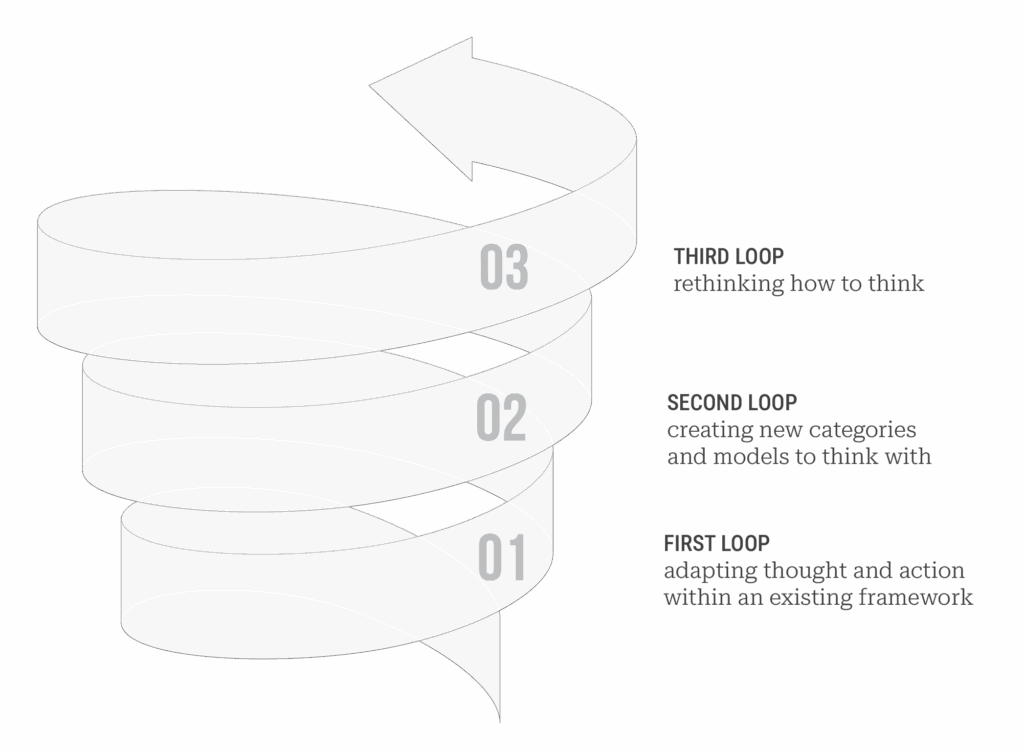
is a concept in organizational learning that goes beyond simply improving actions or questioning assumptions — it challenges the entire framework by which decisions are made.